


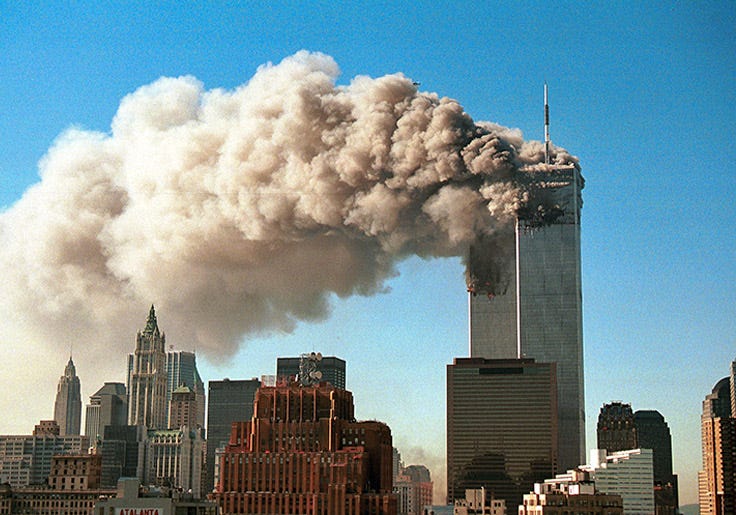
On the 25th anniversary of the September 11 attacks, there is—believe it or not—a debate about why the attacks occurred. Some blame Israel, arguing that the Muslim world’s quarrel with the United States rests only on its relationship with the Jewish state. Others paint the attack as a natural response to U.S. imperialism. “Neither claim is true,” Free Beacon columnist Mike Watson writes. Put simply: It’s not us, it’s them.
Al Qaeda, Watson writes, “came into being during a turbulent moment in the Middle East. Two broad schools of thought had emerged in the Middle East about how to regain a dominant role in world affairs. One camp argued that copying Western institutions would create Western levels of power. The other countered that imitating the early Islamic community would yield greater spiritual, moral, and ultimately political strength. Osama bin Laden created his terrorist group when these Salafists were on the ascent.” He partnered with the Egyptian Islamist Ayman al-Zawahiri, who believed attacking the “far enemy,” the United States, was necessary for overthrowing Arab governments. In his 1996 declaration of jihad against the United States, he wrote that, after Islam, “there is no more important duty than pushing the American enemy out of” the Arabian peninsula and dreamed of the “forthcoming Islamic State” that he would build after defeating the Americans.
“Some appeasers,” then, “thought removing U.S. troops from the region and cutting off Israel would cause bin Laden to focus his ire elsewhere and smooth over tensions with the allegedly aggrieved Arab street, but they were mistaken,” writes Watson. “When bin Laden and Zawahiri crowed about 9/11, Zawahiri complained about the loss of Spain back before Christopher Columbus sailed for the New World. These fanatics sought to conquer the Middle East and then the world. Americans had a longstanding interest in preventing any other country from dominating the Persian Gulf’s oil resources, which put us on a collision course with the jihadists.”
Now, 25 years after the attacks, our country’s military became ruthlessly efficient at finding and defeating terrorists around the world, as the Navy SEALs personally demonstrated to bin Laden in Pakistan in 2011. There are still plenty of al Qaeda allies active, but none have carried out an attack nearly as harmful in the United States. “Shortly after 9/11, bin Laden said, ‘When people see a strong horse and a weak horse, by nature, they will like the strong horse.’ He was right. He just didn’t understand the sources of American strength.”
READ MORE: Why They Hate Us: The Sources of Terrorist Conduct

Jihadists were at war with America before 9/11, targeting us in the 1993 World Trade Center bombing and a plot to bomb New York City landmarks soon thereafter. “A ruthless, ideologically driven foreign enemy, capable of an attack more devastating in scale than Pearl Harbor, waged war against us,” former federal prosecutor Andrew McCarthy writes. McCarthy led the prosecution of the terrorists who carried out the World Trade Center bombing. And yet, he says, “our government responded with subpoenas and arrest warrants, as if the challenge were merely a crime wave.”
In the eight-year pre-9/11 terror wave, the Justice Department managed to prosecute just 29 jihadists. “Only after the mass slaughter of 9/11 did the world’s remaining superpower come to its senses, shifting from a criminal prosecution paradigm to a war-footing,” McCarthy writes in a review of Michael Lebowitz’s Second Wave: Inside Al Qaeda’s Post-9/11 Attack Plan and America’s Secret Effort to Stop It. “This is essential history, particularly if one seeks a reckoning of the erratic fits and starts of that transformation. And that is the problem with Second Wave, an account of plots that comprised the follow-on strikes that Osama bin Laden’s terror network strove to carry out even as it evaded the American military response to 9/11.”
It was obvious before 9/11 that ordinary law enforcement processes were woefully insufficient to quell a threat from foreign terrorist organizations headquartered in overseas badlands where our agencies and courts have no authority. Nevertheless, the Justice Department actually erected internal procedures (the mid-1990s “wall” preventing criminal investigators and intelligence agents from sharing information) that made terror conspiracies even harder to detect. It took the murder of almost 3,000 to convince the government that it needed to change tacks.
Consequently, it’s a troubled legacy. The government was forced to investigate the most atrocious terrorist attack in history, and what then appeared the likelihood of a second wave, while trying to connect the prior five years’ worth of unconnected dots. And while it is one thing to recognize the need to shift from civilian due process to wartime protocols, it is quite another to overhaul the nuts and bolts of complex legal processes on the fly (and with the organized legal profession fighting the transition at every step).
It’s worth remembering that the point of invoking the laws of war is to win the war, not to prioritize due process for the enemy or impede the flow of intelligence derived from interrogation. Indefinite detention denies the enemy resources; military commissions, it was theorized, would deprive the enemy of information that would otherwise be disclosed under judicial procedures. If the assessment of the post-9/11 legacy highlights the travails of detainees and the missteps of government that are on display in Second Wave, the verdict seems indecorous. On the other hand, the jihadist second wave did fail; and a quarter-century later, a hybrid of law enforcement and war footing has made American counterterrorism exponentially more effective than the 2001 vintage. That’s an achievement.
READ MORE: The Rocky Path to Prosecuting Terror

The George W. Bush administration faced criticism from the Left and its friends in the mainstream media, who accused Bush of downplaying the threat of al Qaeda before the attacks then for failing to respond to them in a strategically coherent way. The critics include the journalist Peter Bergen, who is back again with the book All The Presidents’ Wars: Twenty-Five Years of America’s War on Terror, a history of the failed strategies of the American presidents who prosecuted our “Global War on Terror” in the wake of 9/11. Foundation for Defense of Democracies executive director Jonathan Schanzer addresses Bergen’s arguments for the Free Beacon.
One shortcoming of the book is scope. Bergen’s book begins with the failings of George W. Bush. But the story of American presidents and their struggles does not begin there. The failings of Bill Clinton deserve greater scrutiny. He was the first president to deal with the transnational terrorist group we now know as al Qaeda, beginning with its first attack on the World Trade Center in 1993, not to mention the subsequent attacks on two U.S. embassies in Africa in 1998 and the bombing of the USS Cole off the coast of Yemen in 2000. And Clinton treated terrorism as a tactical challenge.
In fact, if Bergen really wanted to examine the history of failed presidential policies toward terrorism, he might have reached as far back as Lyndon B. Johnson, who was forced to grapple with the first hijacking of a plane by the Palestine Liberation Organization in 1968. More than three decades of pre-9/11 counterterrorism policy undeniably informed the decisions of Bush and his successors.
Even more puzzling is why Bergen completely sidestepped the entire question of modern terrorist ideology in the Muslim world and the minority interpretation of Islam that informs it. The motivation for “jihadists” and “Islamists” (two words he uses throughout the book) is never explained. Admittedly, this topic provokes heated controversy and debate. But America’s failures in this asymmetric war must be viewed through this lens. While the names of the terrorist groups continue to change, the enemy’s religiously motivated refusal to surrender has not. This explains much about America’s inability to win.
As for policy prescriptions, Bergen offers few. He contends that better “day after” plans are needed in future wars. And “above all, American presidents must correctly judge and establish the kind of war upon which they and the nation are embarking.” That’s thin gruel for a country still searching for answers 25 years after the worst ever terrorist attack on American soil.
READ MORE: Tiresome Targets in the War on Terror

Additional reading:
Mainstream media outlet Axios is less focused on Hasan Piker’s comment that “America deserved 9/11” and more concerned with how Republicans are responding to them. In a Thursday piece headlined, “GOP uses 9/11 anniversary to bash left-wing Dems,” the outlet wrote, “Republicans are invoking 9/11 to bash left-wing Democrats in a growing number of midterm races, seizing on the 25th anniversary of the attacks to portray them or their supporters as anti-American and sympathetic to terrorists. … It marks the return of a controversial political tactic that was common in the years after the 9/11 attacks but had largely faded from campaigns over the past quarter-century.”
UC Berkeley’s law school illegally used race in admissions to prioritize black applicants over their white and Asian counterparts, the Department of Justice said in a letter sent to Berkeley on Wednesday. It comes after the Department of Health and Human Services found that Duke University’s medical school “intentionally discriminated against white and Asian applicants by using race and race-revealing proxies in its admission practices.”
The rot in academia isn’t confined to higher education. The Trump administration on Thursday launched a federal civil rights investigation into the persecution of Jewish students inside California’s Etiwanda School District, a 14,000-student district in California’s inland empire. It launched a similar probe into the American Musical Dramatic Academy, one of the top schools for developing Broadway stars.
Our full Friday lineup is below.
“Republicans are invoking 9/11 to bash left-wing Democrats in a growing number of midterm races, seizing on the 25th anniversary of the attacks to portray them or their supporters as anti-American and sympathetic to terrorists" -- Perhaps because they are anti-American and sympathetic to terrorists?
They hate us cos they are Muslims. Ain’t that deep.